Buying shoes online is convenient, but choosing the correct size can be confusing. You might normally wear a UK 8, find another pair labelled EU 42, or see a US 9 on a product listing. Are these sizes equivalent? And what should you do when different shoe brands use different sizing systems?
If you are shopping for sneakers, running shoes or casual footwear in Pakistan, understanding your foot measurement can make online shopping easier.
This guide explains how to measure your shoe size at home, understand UK, US and EU sizing, and use your foot length to make a more informed purchase.
Why Measuring Your Feet Matters Before Buying Shoes Online
Many people select shoes based only on the size they usually wear. However, the same number does not always provide the same fit across different brands and shoe designs.
A UK 8 in one brand may not feel exactly like a UK 8 in another. Some shoes have a wider toe box, while others have a narrower shape. Running shoes, casual sneakers and formal footwear can also fit differently.
Measuring your feet helps you:
- Compare your foot length with a brand’s official size chart.
- Reduce the chances of ordering an incorrect size.
- Understand UK, US and EU size labels.
- Make more informed decisions when purchasing pre-owned footwear.
- Ask sellers more useful questions before placing an order.
The most important thing is to measure your feet rather than relying entirely on the size printed on an old pair of shoes.
How to Measure Your Shoe Size at Home
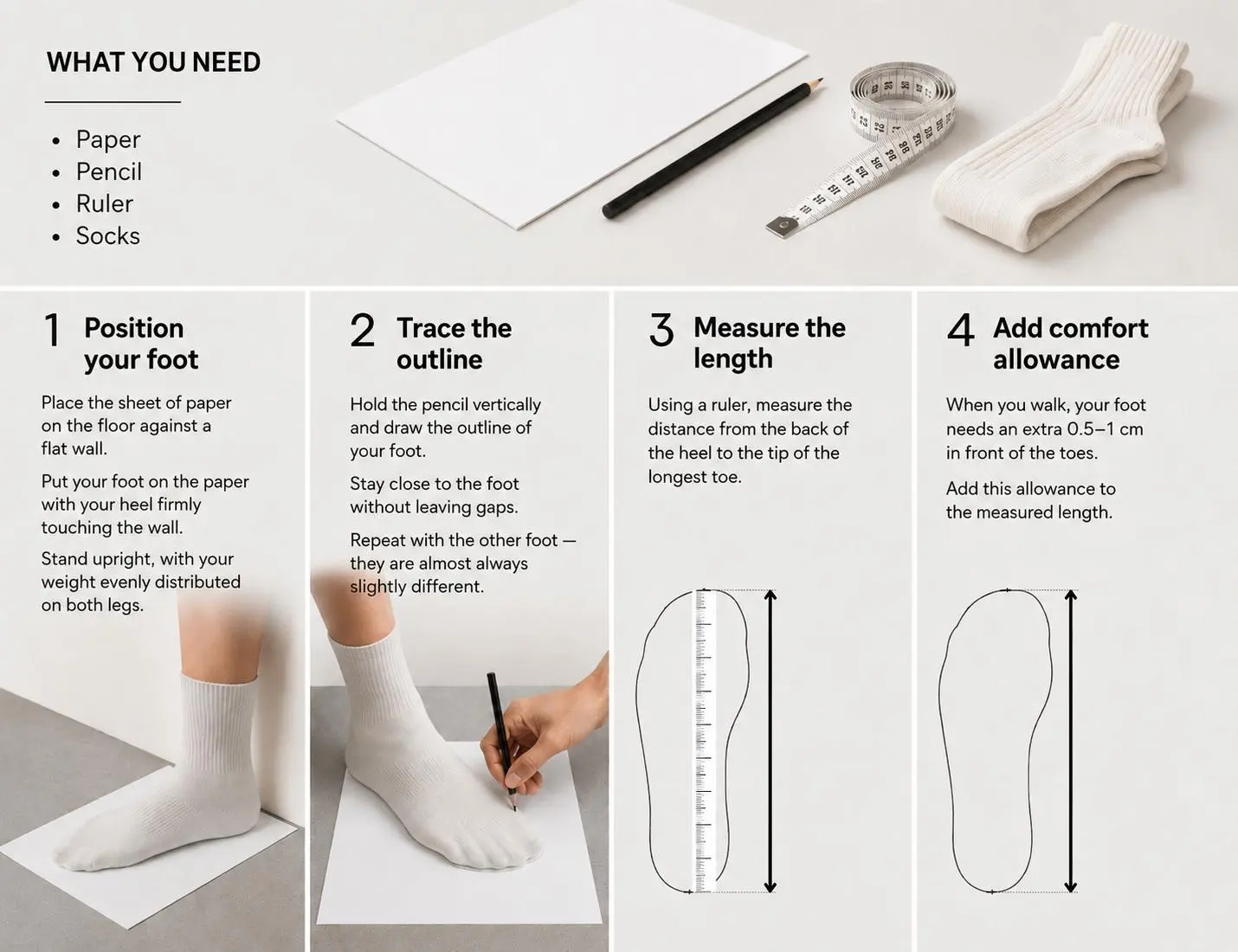
You do not need professional equipment to measure your feet. A sheet of paper, pencil, ruler and a flat wall are enough.
Follow these steps for a simple measurement.
Step 1: Prepare Your Materials
Collect the following items:
- One sheet of paper larger than your foot.
- A pencil or pen.
- A ruler or measuring tape.
- A flat wall.
- The socks you normally wear with your shoes.
Measure your feet while standing, because your weight can affect how your foot spreads against the floor.
Step 2: Place Your Foot Against a Wall
Put the paper on a hard, flat floor with one edge touching the wall.
Stand on the paper with your heel gently against the wall. Keep your weight evenly distributed and your foot straight.
Avoid measuring while sitting because your foot may spread differently when standing.
Step 3: Mark Your Longest Toe
Use a pencil to mark the point in front of your longest toe.
Your longest toe is not necessarily your big toe. For some people, the second toe extends slightly farther.
Make sure the pencil is held vertically so that the mark is as accurate as possible.
Step 4: Measure Your Foot Length
Move your foot away and measure the distance from the edge of the paper that touched the wall to the toe mark.
Record the measurement in centimetres.
For example:
- Left foot: 26.2 cm
- Right foot: 26.5 cm
In this example, the right foot is longer. Use the longer measurement when checking a size chart.
Step 5: Repeat the Measurement
Repeat the process for both feet to avoid mistakes.
It is also helpful to measure your feet later in the day, when they may be slightly larger after normal daily activity.
Keep your measurements written down so you can compare them with different brands’ size guides.
Understanding UK, US and EU Shoe Sizes
When shopping online in Pakistan, you will commonly encounter three shoe sizing systems:
- UK: United Kingdom sizing.
- US: United States sizing.
- EU: European sizing.
These systems use different numbers. A UK size 7, US size 8 and EU size 41 are examples of labels that may appear on footwear, but conversions depend on the brand and the sizing chart.
Do not assume that adding or subtracting one number will always give you the correct equivalent.
What Is UK Shoe Sizing?
UK sizing is commonly found on imported footwear and shoe labels.
If you already own a pair that fits comfortably, its UK size can be a useful starting point. However, check the brand’s official chart before choosing another model.
What Is US Shoe Sizing?
US sizing is another common system. It is especially important to check whether a chart refers to men’s, women’s or children’s footwear.
A US men’s size and a US women’s size are not interchangeable.
What Is EU Shoe Sizing?
EU sizing is widely used on international footwear labels. You may see sizes such as EU 39, EU 40, EU 41 or EU 42.
Some brands also use half sizes or fractional EU sizes, such as 41⅓ or 42⅔.
Always compare the exact label with the appropriate brand chart.
Example: Understanding an adidas Shoe Size Chart
The following examples are taken from adidas’ published footwear size guide. They are provided to demonstrate how different size labels relate to one another within that brand.
| Foot length | US Men’s | UK | EU |
|---|---|---|---|
| 25.5 cm | 8 | 7.5 | 41⅓ |
| 26.3 cm | 9 | 8.5 | 42⅔ |
| 27.1 cm | 10 | 9.5 | 44 |
| 28.0 cm | 11 | 10.5 | 45⅓ |
Important: This is an adidas example, not a universal shoe size conversion chart. Other brands may use different measurements and size recommendations.
You can check the official adidas footwear size guide and Nike men’s footwear size guide for their own sizing information.
Why Shoe Sizes Differ Between Brands
Have you ever purchased two pairs with the same labelled size but found that one felt tighter?
There are several possible reasons.
Different Shoe Shapes
Some shoes are designed with a narrow shape, while others provide more room around the toes.
A shoe’s overall design can affect how it feels, even when its labelled size is identical.
Different Sizing Standards
Brands may use different measurements and conversion methods. This is why an EU size from one brand should not automatically be treated as an exact match for the same EU size from another brand.
Different Shoe Categories
Running shoes, casual sneakers, training shoes and formal footwear may have different shapes and intended fits.
The best approach is to check the size guide for the particular model or product category whenever possible.
How to Choose the Correct Size When Buying Pre-Owned Shoes
Buying pre-owned branded shoes requires a little extra attention because the product is an existing pair rather than a new item available in multiple sizes.
Before placing an order, consider these points:
1. Check the Size Label
Look for the size printed inside the shoe, usually on a label attached to the tongue or lining.
Check whether the size is UK, US or EU. Do not assume the number belongs to a particular system without checking the label.
2. Ask for Additional Measurements
If you are uncertain about the fit, ask the seller whether they can provide an insole measurement in centimetres.
Remember that insole length and foot length are not the same measurement. An insole measurement should be considered alongside the shoe’s shape and available space.
3. Compare Both Shoes
Check that both shoes have matching size labels and that the pair appears consistent.
For pre-owned footwear, inspect the heel, interior lining and insoles as well. Signs of wear can affect the way a shoe feels.
4. Review the Actual Product Photos
Look closely at the product photographs before ordering.
Pay attention to the inside label, outsole, heel area, toe box and overall condition. If something is unclear, ask the seller for additional photographs.
5. Confirm Size Availability
Do not rely on a size being available just because it appears in a general size chart.
A particular pre-owned pair may only be available in one size. Confirm the actual size and condition with the seller before ordering.
Common Shoe Sizing Mistakes to Avoid
Even a small mistake in measurement can lead to an uncomfortable purchase.
Here are some common mistakes to avoid:
- Measuring only one foot instead of both.
- Measuring while sitting rather than standing.
- Assuming UK, US and EU sizes are interchangeable.
- Ignoring the difference between men’s and women’s US sizing.
- Selecting a size based only on an old pair from another brand.
- Confusing foot length with the measurement printed on a shoe label.
- Ordering a pre-owned pair without checking its actual size.
Taking a few minutes to measure your feet can help you make a better decision.
Shop Pre-Owned Branded Shoes Online at Solevix
Once you understand your foot measurements and the different shoe sizing systems, you can make more informed decisions when browsing footwear online.
At Solevix, you can explore pre-owned branded shoes and review the available product details before placing an order.
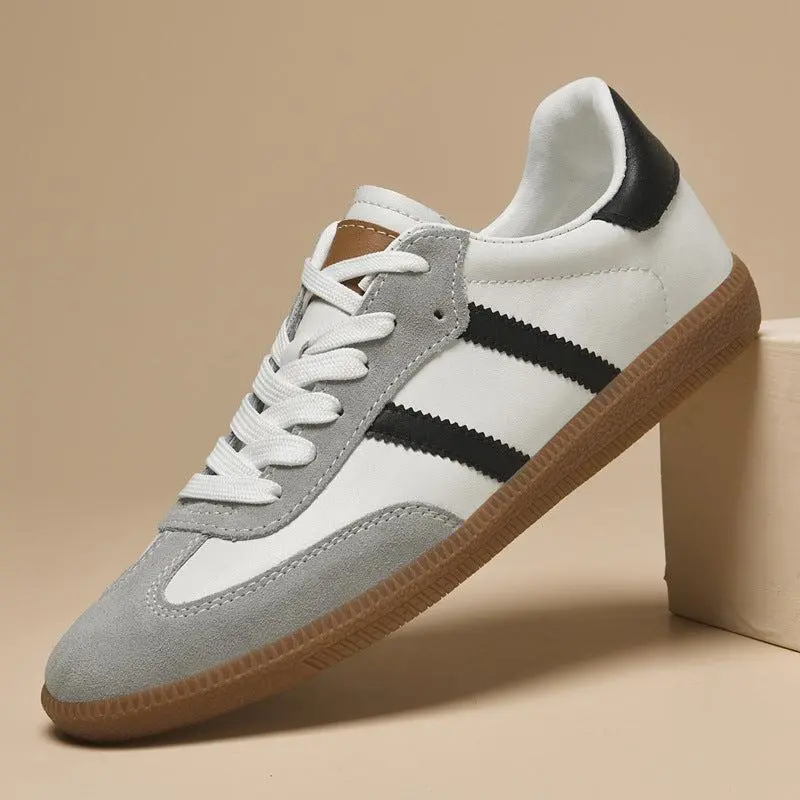
For example, you can view our White Puma Sneakers and check the product information before contacting us to confirm the available size, price and condition.
If you have questions about a particular pair, contact Solevix before ordering so you can confirm the details.
Explore our men’s shoes collection to see the footwear currently listed.
Frequently Asked Questions
1. How can I measure my shoe size at home?
Place a sheet of paper against a wall, stand on it with your heel touching the wall, and mark the end of your longest toe. Measure the distance in centimetres and repeat for both feet.
2. How do I convert UK shoe size to EU size?
Use the official size chart for the shoe brand. UK-to-EU conversions can vary, so a generic conversion should only be treated as a rough reference.
3. Is UK shoe size the same as US shoe size?
No. UK and US sizing systems use different numbers. Also, US men’s and women’s shoe sizes have separate charts.
4. Should I measure both feet before buying shoes online?
Yes. Measure both feet while standing and use the longer foot measurement when comparing it with a brand’s size chart.
5. Is foot length the same as insole length?
No. Foot length is measured from the heel to the longest toe. Insole length is the length of the shoe’s inner sole. They are different measurements and should not be treated as interchangeable.
6. Can I use the same shoe size for every brand?
Not always. Different brands and shoe models can have different shapes and sizing recommendations. Always check the relevant size guide.
7. What should I check when buying used branded shoes online?
Confirm the size label, ask about the actual condition, review clear product photographs and request additional measurements if necessary.
Final Thoughts
Choosing the correct shoe size starts with understanding your own foot measurements. A simple measurement in centimetres can help you compare different sizing systems and make more informed online purchases.
Before ordering footwear, check the brand’s official size chart, consider the shape of the shoe and confirm the actual size available.
Whether you are exploring new sneakers or pre-owned branded footwear, taking these steps can help make your shopping experience more confident and convenient.
Explore available footwear at Solevix and contact us if you need help confirming a product’s size or details.